
11 hours ago
From Publishers Weekly:
A torrent of Internet blogs has poured from U.S. forces overseas, providing a unique view of our wars. Retired officer and blogger Burden does not claim this collection of extracts represents a cross section of what's available, nor does he disguise his biases. All the officers in the book are competent; all the enlisted men and women are brave; and all the husbands love their wives and vice versa. Every writer supports America's war aims, admires the President, despises enemy fighters (generally referred to as terrorists) and holds a low opinion of Americans who oppose the war (generally referred to as liberals). The best (if sometimes troublesome) selections relate personal experiences: a woman trucker is severely wounded; a tanker fights his way into Fallujah, enthusiastically describing the men he kills; a base commander fires an obstreperous Iraqi employee. More literary efforts are less successful, with several wince-inducing attempts at poetic battlefield imagery. Tributes to fallen comrades often fall into mawkishness. Burden warns that unfettered war blogging may soon disappear under the heavy hand of military censorship, but if our leaders are worried about criticism of their policies, Burden's book will reassure them.
Copyright © Reed Business Information, a division of Reed Elsevier Inc. All rights reserved.


After more than a decade of losing elections to Democrats, after three straight presidential losses to Franklin D. Roosevelt -- the man conservative Republicans loved to hate -- the scent of victory was at last in the air for the GOP.Why did they do it? Anyone can tell you....and the reason remains the same.
But there was a problem, and a big one at that. The previous December 7th America had been attacked at Pearl Harbor. The attack was a disaster, killing 2,471 military and civilians and destroying a considerable portion of the U.S. Navy. For the second time in just over twenty years the country was now at war. Not only were we fighting the Japanese but the Germans and the Italians too.
In the partisan camps of the Republican Party there was considerable feeling that the fault for this lay personally with FDR. Some were convinced he either knew the attack was coming and let it happen to plunge the country into the war, or that he should have known and was simply incompetent. The man, they believed, was neither very bright nor very honest. Battlefields were now erupting in strange countries literally all over the world -- in Europe, Africa, Asia. So in circumstances like this, how does a political opposition approach the upcoming election?
Savage FDR? Run on a campaign of "Roosevelt lied and people died"? Should they go out and tell the American people just how dangerously incompetent the man was, that the best thing to do was make peace with Hitler and Japan's Hirohito, then elect Republicans who would simply force FDR to bring home the boys and let the rest of the world cope with chaos? After all, a few years earlier FDR himself had turned back an ocean liner filled with 937 Jews escaping the looming Holocaust. The idea of not making Hitler, Hirohito or Mussolini any angrier than they were was certainly one approach.
The Republicans did none of the above. Instead, with the President on the political ropes at last, with a burgeoning team of attractive GOP candidates all over the country they did something else.
They rallied to FDR.
...
Running for Governor of Connecticut Raymond Baldwin stated flatly that "[t]he President of the United States is our Commander in Chief. Because we are Americans before we are Republicans, we will back him in the conduct of the war. His success is our success and we want him to succeed." At the Republican National Committee, Chairman Joseph Martin pledged "100 percent support of the war effort." And on it went with campaigning Republicans across the country.
And the Nazis and the Japanese? The so-called Axis Powers? What was their response? The New York Times editorial page trumpeted "an admission from Berlin that it would be 'harboring an illusion' to expect the Republican victory to bring any change whatever in the policy of the United States." Focusing on the silence of Nazi propagandist Joseph Goebbels, the paper concluded: "His silence is proof of the fact that we have made the unity of our purpose apparent to our enemies."And what happened to the Republicans in the '42 election? Did they sacrifice their political gain by supporting the nation at war?
The Republicans won the election, gaining 44 new House seats and 10 in the Senate, not quite a majority, but erasing FDR's control. Dewey won in New York and was instantly bannered as a presidential sure thing. GOP gubernatorial candidates won across the country....and people wonder why I feel disgust now and then.
“Lt. Black went to NJP this morning and received no NJP,” said Gittins, who specializes in military cases.Now, let's let that LT go serve his country. We are at war you know. For my $.02: LT Black made a goof, a significant lapse of judgement at a distinct moment in time, but one far more benign than those I have seen Flag Officers make when they were CDRs when I was a wee Ensign/LTjg. Smaller that a lot of what I see now. On par with errors of judgement solid junior officers make because they are imperfect humans in a zero defect organization.
He said Black received a “non-punitive” letter that amounts to “counseling”.
The Naval Academy declined to comment due to privacy considerations of an administrative matter.
According to Navy regulations, a “non-punitive letter” is not considered punishment but intended to “remedy a noted deficiency” and does not stay in an officer’s service jacket.
At a preliminary hearing in August, Gittins told Navy Times that Black has not been teaching at the Academy for the past year, despite orders to Bahrain. According to Naval Academy spokeswoman Judy Campbell, Black has been performing “non-instructional duties.”

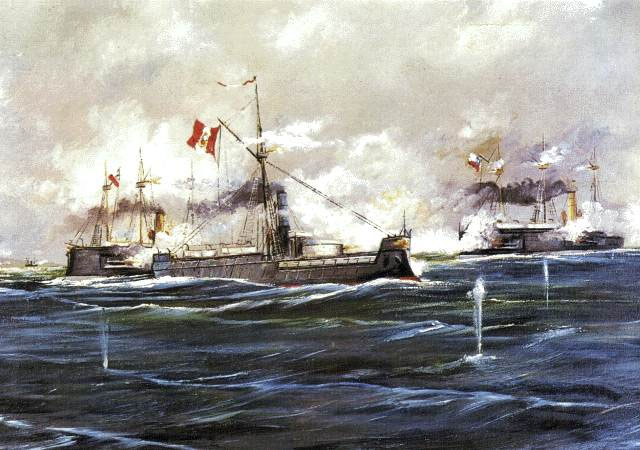 Talk about retro. Let's go WAY BACK for the 1st of SEP. Monitors. South American Monitors. How cool is that? I offer you the Huascar of Chile (after being captured by Peru). This is a ship with a record.
Huáscar participated in the Peruvian Civil War of 1877. Seized at port in Callao by rebels led by retired Captain Germán Astete, she was used to harass, sabotage and disrupt government forces and shipping lanes. During these actions foreign shipping was also affected, leading to British intervention.Best of all, she is still afloat. Give her a visit next time you are in Chile. She is the last of her kind.
On May 29, 1877, she fought the inconclusive Battle of Pacocha against two British vessels, frigate HMS Shah and corvette HMS Amethyst, commanded by Admiral de Horsey. This battle saw the first use in anger of the newly-invented self-propelled torpedo which, at the time, had just entered limited service with the Royal Navy.
...
Huáscar participated in the War of the Pacific, initially in the service of Peru. Once again under the command of Captain Miguel Grau, she became famous for daring harassment raids on Chilean ports and transports. As a result, during the opening months of the war, the ground invasion was delayed for almost six months until the Chilean fleet could find and stop Huáscar.
The Battle of Iquique
Enlarge
The Battle of Iquique
In May 21, 1879, Huáscar led the lifting of the Chilean blockade of Iquique. During the battle, Chilean Captain Arturo Prat was killed on Huáscar's deck while leading a boarding party from the corvette Esmeralda. Notably, after sinking the corvette by repeated ramming, Huáscar then rescued the survivors before continuing pursuit of a fleeing enemy ship.
Huáscar went on with its mission and in the following months accomplished the following:
* Damaged ports of Cobija, Tocopilla, Platillos and Mejillones, Huanillos, Punta de Lobo, Chañaral, Huasco, Caldera, Coquimbo and Taltal
* Sank 16 Chilean vessels, including ships and boats
* Damaged Chilean ships Blanco Encalada, Abtao, Magallanes and Matías Cousiño
* Captured Chilean vessels Emilia, Adelaida Rojas, E. Saucy Jack, Adriana Lucía, Rímac and Coquimbo
* Aboard Rímac, captured 260 men from an elite Chilean cavalry regiment, along with horses, weapons, munitions and supplies
* Recovered Peruvian vessels Clorinda and Caquetá
* Destroyed artillery batteries of Antofagasta
* Cut the Antofagasta-Valparaíso communications cable
Collectively, these actions became known as "Las correrías del Huáscar" ("Huáscar's exploits") and held up a Chilean ground invasion for almost six months. As a result, the Peruvian Navy promoted Captain Grau to Rear Admiral while the Chilean Navy replaced its own chief of staff.
On October 8, 1879, Huáscar was captured by the Chilean Navy at the Battle of Angamos, during which most of Huáscar's crew were killed, including Rear Admiral Grau.
Huáscar then entered the service of the Chilean Navy. At Arica she fought an inconclusive duel with the Peruvian monitor Manco Cápac (formerly USS Oneota) while participating in the bombardment of the city –where her new commander Manuel Thomson was killed– and she also aided in the blockade of Callao.