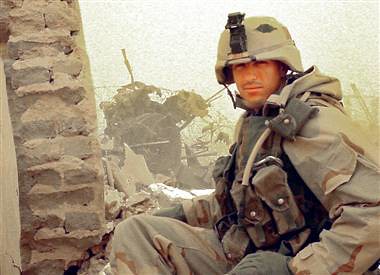
"One of the serious problems in planning against American doctrine that the Americans do not read their manuals nor do they feel any obligations to follow their doctrine."
-- From a Russian military document "
Personally, I think excessive reliance on doctrine is a hobgoblin of small minds.
Well, the post is more of a philosophical concept that applies to any professional Officer, regardless of the color of your uniform. First, not
Since the invasion of Iraq, we have been bombarded with stories about a lack or armored transport (I’m not going to link any, because if you are not already sick reading about the story, you are truly lost) or the shocking, yes shocking (sarcasm), concept that tanks are useful in fighting the enemy somewhere outside the North Plain of Europe or the open desert.
There are common themes that keep coming up in every war in the last 75 years, and we have to learn the basics all over again, every time. I heard a Lt. Col. the other day talking about relearning urban fighting with tanks and how you simply can't get 100% ready for what you are going to see on the battlefield when you get there when you are focused on what Navy Air calls the "Inter-deployment Readiness Cycle." I'm paraphrasing here, but he said something to the effect, "We spent all this time practicing as if we had some open terrain to move around in. The thing is, these things like cities keep popping up in our perfect maneuver warfare world. Too hard to model, we are used to going around them (bypass and haul a55), so we just didn't train to fight in them. We do now though."
A good man doing his best, though with some tunnel vision. Honestly, it wasn't his fault. Folks with stars on their shoulders and too much time as part of
In summary, looking at the latest issues of; 1-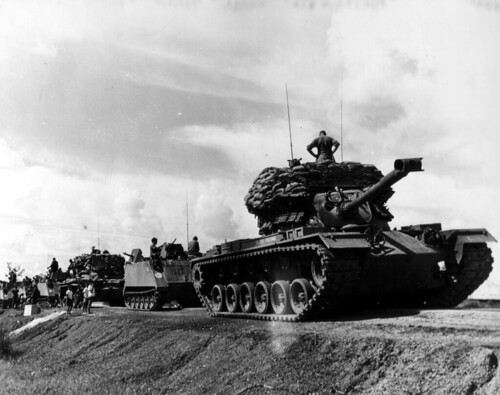
Sandbags look familiar?
MOONBAT and KNEEJERKER WARNING!!!!!! For the below, I am not comparing Iraq to Vietnam. What I am doing is using the mentality and thoughts of 30-40 years ago and comparing them to today as an illustration that we are not doing a good job educating our leaders, or perhaps, not promoting people to the highest positions with significant warfighting perspective to fight the beancounters and planners. We suffer from memory loss as an organization, and again I am not picking on the Army. I could do the same with about anything, but today tanks are cool.
The first quotes are from
Thus at the outset of American participation in the conflict and for some time thereafter, Army planners saw little or no need for armored units in the U.S. force structure in Vietnam.
Now that major combat operations have ended, the mission has evolved to one of peacekeeping and low-intensity engagements -- operations better suited to dismounted infantry proficient in small unit actions.
From early March 1965 until the cease-fire in January 1973, U.S. armored units participated in virtually every large-scale offensive operation and worked closely with South Vietnamese Army and other free world forces. After eight years of fighting over land on which tanks were once thought to be incapable of moving, in weather that was supposed to prohibit armored operations, and dealing with an elusive enemy against whom armored units were thought to be at a considerable disadvantage, armored forces emerged as powerful, flexible, and essential battle forces. In large measure they contributed to the success of the free world forces, not only in close combat, but in pacification and security operations as well. When redeployment began in early 1969, armored units were not included in the first forces scheduled for redeployment, and indeed planners moved armored units down the scale time and again, holding off their redeployment until the very end.
The Marines fought hard in the battle of Najaf, but the Army's role proved decisive. At stake is more than bragging rights. The success of the Army's tanks on the city's narrow streets in the last three weeks casts a new light on efforts to transform the Army by weaning it from the heavy armored vehicles that are a traditional mainstay.
The proponents of this transformation have pushed the Army to become more flexible and fleeter. They argue that lightly armed Soldiers, provided with real-time information about enemy movements and supported by precision air power,
can replace heavy armor, especially against enemies who lack their own.
"We can use precision weapons, in the form of bombs dropped by aircraft, in the form of snipers," said Andrew Krepinevich, executive director of the Center for Strategic and Budgetary Assessments, which studies defense issues.
"Precision allows you to do more with less."
………
The battle for Najaf began on Aug. 5, with American forces fighting guerrillas loyal to the Shiite cleric Moktada al-Sadr. Najaf's old city, with narrow, easily mined streets and buildings that allow guerrillas to fire down on tanks, is in theory dangerous terrain for armored vehicles and better suited to fighting on foot.
Yet in Najaf, two battalions of the Army's tanks did what a lighter marine battalion could not, inflicting huge casualties on Mr. Sadr's insurgents while taking almost none of their own. The 70-ton tanks and 25-ton Bradleys pushed to the gates of the Imam Ali shrine at the center of the old city. Meanwhile, the Marines spent most of the fight raiding buildings far from the old city.
Even so, seven marines died, and at least 30 were seriously wounded, according to commanders here, while only two Soldiers died and a handful were injured.
The difference the armor made was obvious to Soldiers on the ground. "You spot an enemy in a building, you don't want to send guys in, you use Bradleys and tanks," said Specialist Marquis Harrell of the Second Battalion, Seventh Cavalry. "We're glad to have 'em."
Military commanders here say they were somewhat surprised by the tanks' success.
"They myth that we've proven false is that heavy forces can't operate in an urban environment that in the past has been considered a light-fighter environment," said Lt. Col. Myles Miyamasu, commander of the First Battalion, Fifth Cavalry, which fought north of the shrine. Colonel Miyamasu emphasized that he was not trying to play down the contribution of the marines.
Especially ,
"One of the greatest tragedies of life is the murder of a beautiful theory by a gang of brutal facts." --Benjamin FranklinAgain, I’m not an armor expert, but I have a lot of respect for history and the lessons learned written in blood. There are
Oh, and a parting shot for another day and another post, would you rather have your immediate superior on the battlefield have completed 24 months of operational experience, or spent 24 months getting his “Joint” ticket punched at some Staff College? Just a thought, because if I see one more guy that can spout Joint
NB: If my friends in green think I should get back in my dingy and row away, please let me know. As is the norm, there is a transition from peace time to war time military, and the beancounters always rule the roost in peace time. We all fight with what we are given, buy you have to admin, from the relative lack of stopping power of the 9mm on, statements like, "Well, we know it was wrong, but we did it anyway and told everyone it would be fine.", or "We had no idea it would be like this. This is a whole new way of warfare...", gets old after awhile.