Showing posts sorted by date for query hendrix. Sort by relevance Show all posts

Tuesday, March 21, 2023

60-Minutes Does our Navy - and the Nation - a Solid. I'll take the "W."


A regular topic of conversation here and on Midrats (it came up quite a bit on Sunday’s podcast with Jerry Hendrix), is the lack of discussion in the public space about the importance of a strong Navy to our republic’s economic and military security. Sure, inside our salons, slack channels, and email threads we talk to each other a lot, but we seem to have a hard time getting our message out to the general public.

Sunday night’s 60-Minutes was an exception to the rule. There is a lot of credit to go around here. First of all, you have to give credit to the 60-Minutes team fronted by Norah O’Donnell and lead producers Keith Sharman and Roxanne Feitel. This two-segment effort was not just on a topic we all are interested in, it was just plain good journalism.

Sure, I have a nit to pic here and there, but that is just my nature. Perfect? No … but it is one of the best bits of solid, down the middle journalism about our Navy and its challenges I have seen from a major network for a long time. 

If you missed it, CBS has published the video and transcript that I’m going to pull some bits from below for conversation.

The second segment was more meatier than the first, but the first is important. It isn’t just where Big Navy got a chance to make a run at media capture with the "C-2 to the Big Deck at sea" show that we all love, but it will introduce many people to someone who is very good at his job and representing the Navy, Admiral Samuel Paparo, USN.

He gets your attention early by, even though clearly well prepared and sticking to scripted talking points and marketing pitches here and there of questionable utility, he also spoke in blunt terms in a way we don't hear enough in venues such as this;

Admiral Samuel Paparo commands the U.S. Pacific Fleet, whose 200 ships and 150,000 sailors and civilians make up 60% of the entire U.S. Navy.  We met him last month on the aircraft carrier USS Nimitz deployed near the U.S. territory of Guam, southeast of Taiwan and the People's Republic of China, or PRC.

Norah O'Donnell: You've been operating as a naval officer for 40 years. How has operating in the Western Pacific changed?

Admiral Samuel Paparo: In the early 2000s the PRC Navy mustered about 37 vessels. Today, they're mustering 350 vessels.

...

60 Minutes has spent months talking to current and former naval officers, military strategists and politicians about the state of the U.S. Navy. One common thread in our reporting is unease, both about the size of the U.S. fleet and its readiness to fight. The Navy's ships are being retired faster than they're getting replaced, while the navy of the People's Republic of China or PRC, grows larger and more lethal by the year. We asked the commander of the U.S. Pacific Fleet, Admiral Samuel Paparo, about this on our visit to the USS Nimitz, the oldest aircraft carrier in the Navy.

Admiral Samuel Paparo: We call it the Decade of Concern. We've seen a tenfold increase in the size of the PRC Navy. 

Norah O'Donnell: Technically speaking, the Chinese now have the largest navy in the world, in terms of number of ships, correct?

Admiral Samuel Paparo: Yes. Yes.

Norah O'Donnell: Do the numbers matter?

Admiral Samuel Paparo: Yes. As the saying goes, "Quantity has a quality all its own." 

This is exactly how the answer needs to be delivered. No squish, no excessive spin - acknowledge the reality of where we are. 

More of this from more senior leaders.

There was some subtlety as well. When he first said this, about 10-seconds later I decided to rewind to listen to it again. 

Norah O'Donnell: And if China invades Taiwan, what will the U.S. Navy do?

Admiral Samuel Paparo: It's a decision of the president of the United States and a decision of the Congress. It's our duty to be ready for that. But the bulk of the United States Navy will be deployed rapidly to the Western Pacific to come to the aid of Taiwan if the order comes to aid Taiwan in thwarting that invasion.

Norah O'Donnell: Is the U.S. Navy ready?

Admiral Samuel Paparo: We're ready, yes. I'll never admit to being ready enough.  

Did you catch that? He can't say, "We're not ready." as if the call comes, we can and will execute what we are tasked ... and initially will be ready to do what we can with the reduced numbers we have ... but everyone knows there is a huge asterisk next to "ready." 

We don't have enough escort ships. We don't have enough VLS tubes. We don't have a large enough airwing with long enough legs. We don't have enough reliable and robust tanking. We don't have much of a bench ... so, we are "ready" - but not even close to being "ready enough." A subtle distinction with not so subtle implications.

We also need to give a nod to our Navy for not having only the 4-stars talk to CBS. LCDR David Ash, USN got some good face time with the camera, and his fellow LCDR Matthew Carlton, USN blessed us with his superb deployment stash.

60-Minute's graphics department also gets credit for the video that the pic at the top of this post is a screen capture of. 

One of the most important things someone can do who is interested in understanding the western Pacific from the PRC's POV is to see it from their shores in an east-up orientation. Where only a small group of PRC focused navalists have shared the image or have that projection on their wall were blessed with that perspective, now it is in the minds of at least hundreds of thousands more people.

This is how the Chinese Communist Party sees the Western Pacific, including the South and East China Seas from Beijing. Taiwan is the fulcrum in what China's leaders call "the first island chain," a constellation of U.S. allies that stretches across its entire coast.  Control of Taiwan is the strategic key to unlocking direct access to the Pacific and the sea lanes where about 50% of the world's commerce gets transported.

Norah O'Donnell: China has accused the United States of trying to contain them. What do you say to China?

Admiral Samuel Paparo: I would say, "Do you need to be contained? Are you expanding? Are you an expansionist power?" To a very great extent, the United States was the champion for China's rise. And in no way are we seeking to contain China. But we are seeking for them to play by the rules.

...and that is where the friction lies. The PRC holds the "rules" in contempt because they had no role in making them. As they don't like the rules, they are bit by bit changing them. From creating no-go zones in the South China Sea that once were open seas, to putting their flag down on the island nations of the southwest Pacific, to bending policies in Latin American nations, to being an observer at the Arctic Council to match their Arctic strategy.

Rules can, and are, being changed.

There was another point where Admiral Paparo put a marker down that someone can pick up and run with ... hey, I think I'll do that now;

Norah O'Donnell: How much do you worry about the PLA Rocket Force?

Admiral Samuel Paparo: I worry. You know, I-- I'd be a fool to not worry about it. Of course I worry about the PLA Rocket Force. And of course I work every single day to develop the tactics and the techniques and the procedures to counter it, and to continue to develop the systems that can also defend-- against them.

Norah O'Donnell: About how far are we from mainland China?

Admiral Samuel Paparo: Fifteen hundred nautical miles.

Norah O'Donnell: They can hit us.

Admiral Samuel Paparo: Yes they can. If they've got the targeting in place, they could hit this aircraft carrier. If I don't want to be hit, there's something I can do about it.

Ahhhhh, yes. Time to bring back one of my favorite graphics.


Draw a 1,500nm circle from the PLARF launch sites and look at what land based airfields, bases, depots and facilities of all sorts are located under that threat. They cannot move. A navy and sea based facilities can.

Undersold point, but Paparo is leaving it there for you to run with.

As a recidivist staff weenie, I swelled with pride at this moment. Nothing happens by accident;

Norah O'Donnell: I just noticed out of the corner of my eye. 

Admiral Samuel Paparo: This is a 688 class, a Los Angeles-class attack submarine. This is the most capable submarine on the planet. You know, with the exception of the Virginia class, our newer class of submarines.

Someone on that staff needs a NCM. Having that SSN heave in to view at that time and that place is simply 5.0 staff work. BZ to everyone, and like most of this visit, just all around well done. 

We've all seen such opportunities not work out all that well, but the time on NIMITZ was simply our Navy at its best. Paparo's staff, the crew of NIMITZ, the Strike Group, and Airwing all just did a superb job. Yes, there were a few PAOisms and talking points, but the visit and interviews were honest and praiseworthy. Paparo will get most of the credit, but everyone underway on that visit just did a superb job.

However, the following comment gave me pause, and it serves to make a point...I think.

Norah O'Donnell: How much more advanced is U.S. submarine technology than Chinese capability?

Admiral Samuel Paparo: A generation.

Norah O'Donnell: A generation.

Admiral Samuel Paparo: And-- by generation, think 10 or 20 years. But broadly, I don't really talk in depth about submarine capabilities. It's the silent service.

OK, I left active duty 13 yrs ago or so, but ... ummm ... I recall the PLAN submarine force then, and I also know roughly what the state of the US SSN were in 2013 and 2003, 10 and 20 years ago. If the PRC is pushing out new construction on par with what we were building even in 2003, much less 2013 ... ummm ... eek. 

To avoid me having a drop, flop, and foam panic attack, we'll call it an overstatement mulligan.

Also, that SSN is an LA Class SSN. I'm not sure which one, but the last one was commissioned in 1996. That was 27 years ago.

So. Let's just leave that there to simmer.

Norah O'Donnell: One recent-- nonclassified war game had the U.S. prevailing but losing 20 ships, including two carriers. Does that sound about right?

Admiral Samuel Paparo: That is a plausible outcome. I can imagine a more pessimistic outcome. And I can imagine a more optimistic outcome. We should be clear-eyed about the costs that we're potentially incurring 

There are about 5,000 Americans on board the Nimitz.  The ship is nearly half a century old. Given the Navy's current needs in the Pacific and because there's fuel left in its nuclear reactors, the carrier's life at sea is going to be extended.

Again, Paparo does a superior job here, but I want to take the last bit to remind everyone what war at sea looks like. Does everyone here fully understand what a loss of two CVN and 18 other ships would mean? 

Let's go back to March 10th's FbF about the loss in combat of the USS Laffey (DD-459),

Out of that crew of 208?  57 KIA/114 WIA. That is an 82% casualty rate.

We have 5,000 Sailors on each CVN. That is 10,000 Sailors. Let's uses a round number from a Flight II Arleigh Burke DDG manning of 300 as we don't know in that wargame what the other 18 ships were lost. That gives you another 5,400 Sailors for 15,400 total. 

With a 82% casualty rate, that is 12,628 Sailors; 4,158 killed and 8,470 wounded. That is almost as many killed in the last two decades fighting in Iraq (4,431). 

Killed not in 20 years, but a few weeks to months - maybe days.

That is what it is all about, which leads us to a great point brought up by two of the best people who served in the last Congress, Representative Mike Gallagher (R-WI) and Representative Elaine Luria (D-VA). 

Again, the right people to talk to.

Norah O'Donnell: What is it about the U.S. Navy that has allowed the two of you to find common cause?

Rep. Mike Gallagher: I think we-- share a sense of the urgency of the moment. We see increasing threats from China in particular in the Indo-Pacific. We feel like we're not moving fast enough to build a bigger Navy.

...

Norah O'Donnell: What would you say the state of the U.S. Navy is today?

Rep. Elaine Luria: I think the Navy has not received the attention and resources that it needs over two decades. I mean, I served on six different ships. Every single one of those ships was either built during or a product of the fleet that was built-- in the Cold War. 

Both Mike Gallagher and Elaine Luria have lobbied for government money for the shipyards in or near their districts, but they say this is less about jobs and more about national security. 

Rep. Elaine Luria: If we don't get this right, all of these other things we're doing in Congress ultimately-- might not matter.

She is exactly right - it might not matter. That is a deep comment we should all stop and ponder a bit.

There were a few Easter Eggs here for the Front Porch. You should all take a moment to savor. We've been at this together for almost two decades. Our arguments have soaked in. Enjoy:

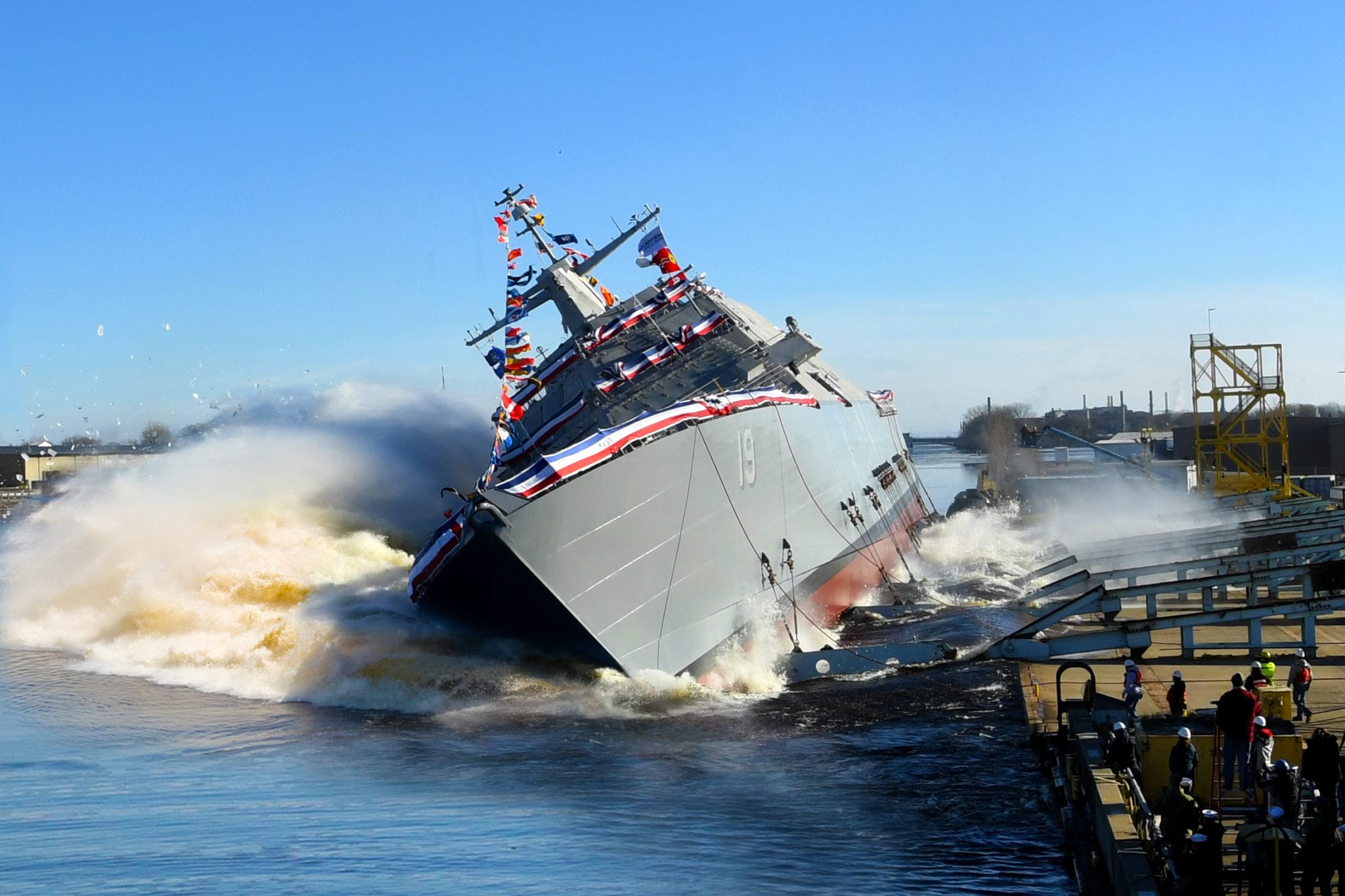
Over the last two decades, the Navy spent $55 billion on two investments that did not pan out. The first was a class of Destroyers known as the Zumwalt. The futuristic fighting ships were supposed to revolutionize naval warfare. Thirty-two were ordered, but only three were ever launched. The cost of each ship, by one estimate, was upwards of $8 billion, making them the three most expensive Destroyers ever put to sea.

Another example is the Littoral Combat Ship or LCS, designed to be a fast all-purpose warship for shallow waters. Thirty billion dollars later the program ran aground after structural defects and engine trouble. Within the Navy, the LCS earned the unfortunate nickname, little crappy ship.

Norah O'Donnell: The Navy's last few decades have been described as a lost generation of shipbuilding. Is that overly dramatic? 

Don't get too full of yourselves folks, but take a bow. It wouldn't be there without you.

Next we had the CNO. He was a bit more off then on here. He looked if not unwell, at least very tired. Where Paparo gets an A- for his appearance - well prepared but not over scripted - I think the CNO got at best a B- as he was over-prepared and ready with talking point phrases that were just not appropriate for the moment. 

There were some things that just clunked;

Norah O'Donnell: Is the Navy in crisis?

Admiral Mike Gilday: No, the Navy's not in crisis. The Navy is out on point every single day.

Norah O'Donnell: Is it being outpaced by China? 

Admiral Mike Gilday: No. Our Navy's still in a position to prevail. But that's not blind confidence. We are concerned with the trajectory that China's on, with China's behavior. But we are in a good position right now-- if we did ever get into a fight against them. 

Ummm, CNO; no one thinks our Navy is doing great right now. This was not a rah-rah moment, this was an opportunity to ask for help to get our maintenance, stores, and fleet numbers aligned with requirements. A lost opportunity. His comments are simply not aligned with an objective review of the facts on the ground.

We should be less concerned with the trajectory the PRC is on - which we can't control - but with the trajectory we are on - that we can.

Another morale booster for the Front Porch, the CNO did repeat something he states on a regular basis and good for him that he does. Spot on.

Admiral Mike Gilday: I think one of the things that we learned-- was that we need to-- have a design well in place before we begin bending metal. And so we are going back-- to the past, to what we did in the '80s and the '90s, the Navy has the lead.

In the first and second decades of this century, how many people rolled in to comments here to tell us our critique represented "old think," that we didn't get the "new Navy" or were disconnected from "new methods?" 

Well, ha! He who laughs last laughs best. We were right, and in 2023, the CNO is with us circa 2004.

Especially for those who are subscribers to the Midrats podcast (going in to its 14th year) and readers here through the years, one of our regular and favorite guests made and appearance, Toshi Yoshihara; 

Toshi Yoshihara: China will have about 440 ships by 2030. And that's according to the Pentagon.

Norah O'Donnell: Why is China able to build more warships more quickly than the U.S.?

Toshi Yoshihara: China has clearly invested in this defense industrial infrastructure to produce these ships, which allows them to produce multiple ships simultaneously, essentially outbuilding many of the western navies combined.

They then went on to discuss issues with industry that in addition to what we linked to at the top of the post, we also discussed with Jerry Hendrix on last Sunday's Midrats.

If you want more Toshi, you can listen to his January visit to Midrats, or read his latest book we talked about; Mao's Army Goes to Sea: The Island Campaigns and the Founding of China's Navy.

Again, the CNO lost another opportunity by refusing to state hard truths.

Norah O'Donnell: What do you see when you see China's shipbuilding program?

Admiral Mike Gilday: It's very robust.

Norah O'Donnell: Do we have enough shipyards?

Admiral Mike Gilday: No. I wish that we had more commercial shipyards. And-- over my career, we've gone from more than 30 shipyards, down to about seven that we rely upon on a day-to-day basis to build ships. 

Going back to his "no crisis" comments earlier - I'm sorry, but the above is a crisis and needs to be spoken of and acted on as such. We have allies in Congress ... we can make this push ... but we need out senior uniformed leaders to ... well ... lead on this fight.

If, as Paparo says, we have a "decade of concern" then we need to focus on what we can get to displace water and make shadows on the ramp in the next decade that we know can project power at range. It is time to push the pie-in-the-sky, perpetually oversold, transformationalist, bullshit Tomorrowland stuff to the back burner both in the budget ... and unquestionably on the public stage.

Admiral Gilday says the U.S. Navy's main advantage over China is America's sailors.  His goal is to modernize the U.S. fleet and have those sailors serving alongside hundreds of unmanned vessels by 2045.

Admiral Mike Gilday: I think unmanned is the future. And so I think that-- some 40% of our fleet in the future, I believe, is gonna be unmanned. 

Own goal. Complete distraction and off topic to the challenge at hand. On top of that, he's poorly briefed and wrong.

2045 is to today what today is to 2001. Look at what we deployed with in 2001 and what we have today. That is your slope.

There will not be that big of a shift to unmanned due to legal, technological, and C2 challenges as well as and simple logic and experience. 

What an incredibly irresponsible stance to say such thing at this in this venue. It hobbles future leaders and managers who have to put credible platforms at sea that our Sailor will need to go to war in well before some vapor-ware 2045 fever dream.

40% my ass. Whoever briefed him that this was a good place to bring this up should be fired...or he tripped himself on one of his preplanned talking points. 

We did have a recovery at the end. The show, and the CNO, ended strong. It was a great close that sells well and gets attention. We needed more of this, and maybe there was on the cutting room floor. Usually there is what, 5-hrs of interviews for a 5-minute segment?

So, nice end.

Norah O'Donnell: The U.S. defense posture is viewed as aggressive by the Chinese. The foreign minister just said, "Look, stop the containment. This may lead to conflict." 

Admiral Mike Gilday: Perhaps the Chinese minister doesn't like the fact that the U.S. Navy is operating in collaboration with dozens of navies around the world to ensure that the mar-- maritime commons remains free and open for all nations. The Chinese wanna dictate those terms. And so they don't like our presence. But our presence is not intended to be provocative. It's intended to assure and to assure-- to reassure allies and partners around the world that those sea lanes do remain open. The global economy literally floats on seawater.



Saturday, March 18, 2023

Episode 650: Keeping America's Dominance at Sea with Jerry Hendrix

Except for those over a 85, no one alive has ever existed at a time when the US Navy was not the premier naval power - and no one alive at all has known a world where the US Navy was not the premier naval power in the Pacific.

Though on paper it could be challenged in the first third of the 20th Century by the Royal Navy, and was challenged in a very real way by the Imperial Japanese Navy in the Pacific in the early mid-century, after the 1930s no industrial power could hope to compete with the United States in production and warships ready to fight at sea in a major conflict.

During the Cold War, there were a couple of decades where the Soviet Union could put a fleet to sea to give the US Navy regional concern, but never really on an ocean wide scale.

As we approach the end of the first quarter of the 21st Century, a rising power is presenting a challenge in the Pacific the US Navy, and its political leaders, seem to have trouble accepting.

The People's Republic of China is clear that it wants the global power the USA presently has - including on the high seas. 

Returning to Midrats Sunday from 5-6pm Eastern to discuss his recent article in The Atlantic, "The Age of American Naval Dominance is Over" is Jerry Hendrix, PhD.

Jerry is a retired USN Captain, author, and a senior fellow with the Sagamore Institute, in Indianapolis. His most recent book is To Provide and Maintain a Navy (2020).

Join us live if you can, but it not, you can get the show later by subscribing to the podcast. If you use iTunes, you can add Midrats to your podcast list simply by clicking the iTunes button at the main showpage - or you can just click here. You can find us on almost all your most popular podcast aggregators as well.

Wednesday, March 15, 2023

Hendrix's View from an Island Nation


Regular readers know the importance of the United States being the world’s premier sea power, but that is inside the lifelines of our corner of the national conversation. 

For a whole host of reasons we have discussed here over the years and on Midrats – in spite of our nation surrounded by the fruits of the open seas – the larger American public does not see it. We suffer, in essence, from our success.

The time when the free flow of goods across the globe was not a given has slipped well out of living memory. Except for older cohort GenX and older, no one even remembers the regional threat the Soviet Red Banner Fleet aspired to be right before the empire she served collapsed and disaggregated.

Not just the United States, but the developed and developing nations throughout the globe who benefit from the post-WWII maritime environment suffer from seablindness. There are other powers - resentful, bitter, and grasping – who even though they benefit from the global agreement – wish to break it down and create something new. Not so much that they want something better – they just don’t like a system they had no role in creating – one defined by the assumed ever-presence of the United States Navy and her friends.

As fish are not aware of the water they swim in, so the global economy does not fully understand the world it exists in … and the fact that it is under threat of disappearing. 

Our friend Jerry Hendrix has been an integral and valuable part of the public conversation for well over two decades – longer inside the lifelines of the US military. 

This month he has an exceptional article over at The Atlantic titled, “America’s Future is at Sea” or in the more flashy online version, "The Age of American Naval Dominance is Over" that you need to take time to read. He weaves together not just the history, but the economic, diplomatic, and civilizational threads that all connect to American seapower. 

What adds additional importance to his article is the venue. 

As I mentioned in the opener to this post, “we” know this story – or at least most of it. The problem is too many others do not. 

The Atlantic has a certain readership segment which includes many people of influence and proximity to the levers of power, or a degree or two separated from someone who does. The vast majority of its readers who are not soaked in the details involving the maritime domain.

These people need to understand the issues as much as readers here do. You really need to read it in full, but here are a few pull quotes I’d like to share. He starts out strong;

Very few Americans—or, for that matter, very few people on the planet—can remember a time when freedom of the seas was in question. But for most of human history, there was no such guarantee. Pirates, predatory states, and the fleets of great powers did as they pleased. The current reality, which dates only to the end of World War II, makes possible the commercial shipping that handles more than 80 percent of all global trade by volume—oil and natural gas, grain and raw ores, manufactured goods of every kind. Because freedom of the seas, in our lifetime, has seemed like a default condition, it is easy to think of it—if we think of it at all—as akin to Earth’s rotation or the force of gravity: as just the way things are, rather than as a man-made construct that needs to be maintained and enforced.

But what if the safe transit of ships could no longer be assumed? What if the oceans were no longer free?

Nothing is guaranteed ... or as Papa Salamander would often tell me, "No one owes you a living."

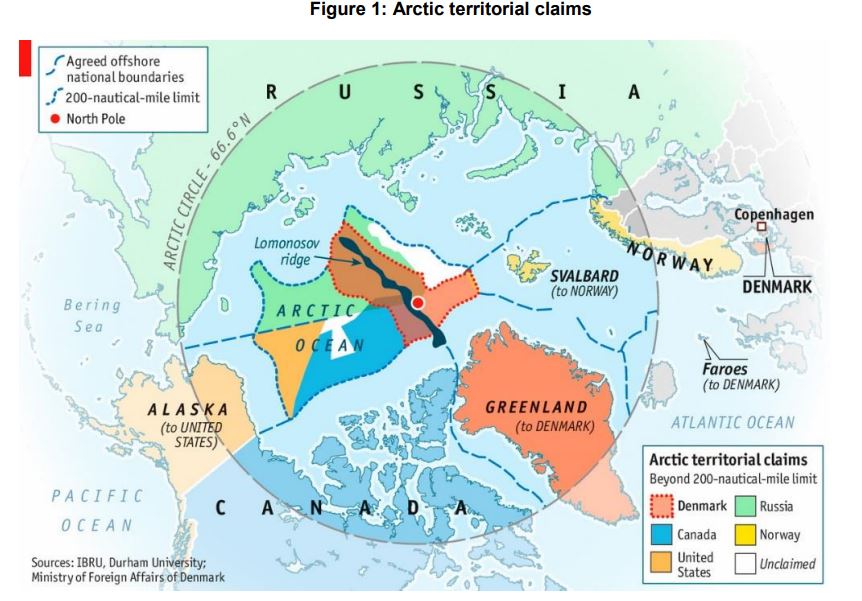
Imagine, though, a more permanent breakdown. A humiliated Russia could declare a large portion of the Arctic Ocean to be its own territorial waters, twisting the United Nations Convention on the Law of the Sea to support its claim. Russia would then allow its allies access to this route while denying it to those who dared to oppose its wishes. Neither the U.S. Navy, which has not built an Arctic-rated surface warship since the 1950s, nor any other NATO nation is currently equipped to resist such a gambit.

Or maybe the first to move would be Xi Jinping, shoring up his domestic standing by attempting to seize Taiwan and using China’s anti-ship ballistic missiles and other weapons to keep Western navies at bay. An emboldened China might then seek to cement its claim over large portions of the East China Sea and the entirety of the South China Sea as territorial waters. It could impose large tariffs and transfer fees on the bulk carriers that transit the region. Local officials might demand bribes to speed their passage.

"Gentlemen's agreements" only work if both parties act as gentlemen and keep their word. What happens when one party decides not to be? What is the enforcement mechanism ... or is there one at all?

If oceanic trade declines, markets would turn inward, perhaps setting off a second Great Depression. Nations would be reduced to living off their own natural resources, or those they could buy—or take—from their immediate neighbors. The world’s oceans, for 70 years assumed to be a global commons, would become a no-man’s-land. This is the state of affairs that, without a moment’s thought, we have invited.

This is not alarmism. A discordant and ill-timed blending of demography, debt, economics, and politics are driving the global system of crisis - what we warned of starting 13-yrs ago as "The Terrible 20s."

—a “free sea”—first enunciated by the Dutch philosopher Hugo Grotius in 1609. The United States and Great Britain, the two traditional proponents of a free sea, had emerged not only triumphant but also in a position of overwhelming naval dominance. Their navies were together larger than all of the other navies of the world combined. A free sea was no longer an idea. It was now a reality.

In this secure environment, trade flourished. The globalizing economy, which allowed easier and cheaper access to food, energy, labor, and commodities of every kind, grew from nearly $8 trillion in 1940 to more than $100 trillion 75 years later, adjusted for inflation. With prosperity, other improvements followed. During roughly this same period, from the war to the present, the share of the world’s population in extreme poverty, getting by on less than $1.90 a day, dropped from more than 60 percent to about 10 percent. Global literacy doubled, to more than 85 percent. Global life expectancy in 1950 was 46 years. By 2019, it had risen to 73 years. 

What happens if global trade retrogrades to a prior, less safe, less predictable (hurting insurance carriers ability to properly set rates) and vibrant time? Well, you look at the positive effects of growth in the past to see an inverse of what a return to the multipolar ocean might bring the future. That is what Jerry just did. Re-read the above and ponder even a fraction of that headwind;

It is important as we look at today's challenge to accept that we are not a passive victim of a changing world. No. We are here mostly as a result of our own actions. Decline is a choice.

As a side note, if you are not already thinking of another article in The Atlantic from 16 year's ago, Robert D. Kaplan's "America's Elegant Decline," go ahead and read it now.

It is never to a nation’s advantage to depend on others for crucial links in its supply chain. But that is where we are. In 1977, American shipbuilders produced more than 1 million gross tons of merchant ships. By 2005, that number had fallen to 300,000.

Today, most commercial ships built in the United States are constructed for government customers such as the Maritime Administration or for private entities that are required to ship their goods between U.S. ports in U.S.-flagged vessels, under the provisions of the 1920 Jones Act.

The U.S. Navy, too, has been shrinking. After the Second World War, the Navy scrapped many of its ships and sent many more into a ready-reserve “mothball” fleet. For the next two decades, the active naval fleet hovered at about 1,000 ships. But beginning in 1969, the total began to fall. By 1971, the fleet had been reduced to 750 ships. Ten years later, it was down to 521. Reagan, who had campaigned in 1980 on a promise to rebuild the Navy to 600 ships, nearly did so under the able leadership of his secretary of the Navy, John Lehman. During Reagan’s eight years in office, the size of the Navy’s fleet climbed to just over 590 ships.

Then the Cold War ended. The administrations of Presidents George H. W. Bush and Bill Clinton slashed troops, ships, aircraft, and shore-based infrastructure. During the Obama administration, the Navy’s battle force bottomed out at 271 ships. Meanwhile, both China and Russia, in different ways, began to develop systems that would challenge the U.S.-led regime of global free trade on the high seas. 

Read it all.

If this isn’t enough Hendrix, and there is never enough, Jerry will join us this upcoming Sunday for Midrats. Don’t miss it!


Friday, February 24, 2023

The Russo-Ukrainian War D+365 Quicklook

The three day war Russia thought it started a year ago is still going strong.

There are a lot of "One Year" think-pieces out there that are long and detailed. I want to keep things short. 

On the day the war started I made 7-points. Let's review them and see how I did back on 24 FEB 22.

1. The remaining delusions about the post-Cold War security arrangements in Europe should be firmly buried. History is back and she has her Festivus pole front and center. She has some issues with us, and we’re going to hear about it.

This continues to get firmer and displayed in stark relief. All the "offsets" and "transformations" and "war is new" snake oil sold the last few decades really should not be allowed to have any public space besides to say, "I was wrong." Rest assured, that won't stop them - but the issues we raised over the almost 18-yrs of this blog and 14-yrs of the Midrats Podcast remain true. From the shallow magazines to the fact you never have enough large caliber guns to no war is short ... we - and a lot of other people tut-tut'd for years - were correct.

2. NATO has a German problem. While all the “right people” will not shut up about how wonderful former Chancellor Angela Merkle was, people need to be very clear eyed about what a complete disaster she and the German political class have been over the last two decades. They have starved what should be continental European NATO’s most potent military into irrelevance. Her disastrous feel-good, ethno-masochistic immigration policy weakened European cohesion and fed the worst parts of European political subcultures. Yes, she made a lot of well meaning Germans feel good about themselves, but it was a sugar-high that rotted the teeth and poisoned the national metabolism. While willing to defend Europe to the last Pole and Germany to the last American, she decided to preen in her neo-pagan EuroGreen superiority onomastic politics by ditching clean nuclear power and through the complete corruption of her elite, shacked herself to Russian energy oligarchs and thus the Kremlin. Germany needs to fix herself, and NATO needs to work around her and punish her until she starts to behave like a constructive 21st Century security partner.

Germany has made great progress, but is being dragged kicking and screaming in to the 21st Century. 

3. As our friend Jerry Hendrix pointed out yesterday, the moral leaders in NATO right now are the Baltic Republics and I would add Visegrad nations. You can throw Romania in there too. France will go hot and cold as she fights her desire to do the right thing for European security while at the same time nurse her 1,000 year old drive to be the premier leader of Western Europe. Serious but weaker nations will lean on a reluctant USA and limited United Kingdom … simply because - to be frank - much of the rest of the alliance is not that capable.

I think this graph tells that story well;

The front-line nations are putting their money where their existential threat is.

4. In line with #1 above, it is time for Finland at least, and probably Sweden, to join NATO. They both have a long and bloody history with the Russians and should see clearly what time it is.

Another check.

5. Ukraine waited too long to rearm. Weakened and distracted by a corrupt elite, the good parts of her nation could not get ready fast enough. After the first Russo-Ukraine war of 2014 she should have modeled the armed neutrality of Switzerland with a civilian populace trained and armed to the teeth. As we’ve discussed here before with the former Soviet republics and Warsaw Pact nations, every village needs a few ATGM militia teams trained to slow any advance through their patch of land. If Ukraine can, in whole or part, survive without vassalhood, perhaps they could get there. They can only get there if they build a nation people are willing to fight and die for.

Everyone is rediscovering the utility of a good military-industrial complex that can quickly grow to scale. Amazing what the green-eye-shade accounts forced those who actually are supposed to study war to believe.

6. Remember, the Russians hold the Presidency of the UN Security Council. The UN is a joke. OSCE is a joke. The EU is little more than a nest of rent-seeking, clock-watching grift-fest. NATO is, well, dysfunctional but better than nothing. Nations must take ownership of their own security. Yes, Taiwan and Japan I am talking to you. Study history. Be ready.

Well, this was kind of a lame point. The UN is, well, lame.  However the end of the point is solid. We'll call it a draw.

7. Is everyone clear what Russia is now? She has a small GDP and apocalyptic demographics, but she is taking what she has and is invading her neighbors, killing people, and taking land. If your nation, company, or neighbor is buying anything from them – they are paying for this military adventurism. If the press wants to do its job, start pulling that string.

Not enough thread pulling on the economic support for Russia around the globe. Make no mistake, a lot of the worst people are making money doing business with Russia. That money buys influence and silence.

Where is this reporting?

So, what are the lessons a year later? We'll discuss that Monday.

Wednesday, November 16, 2022

Chaos is a Ladder: Opportunity in the High North


Before the Russo-Ukrainian War kicked off in February, on the Top-5 lists of any navalist worth their salt was the Arctic. If you are an Atlanticist/NATO type, it was in your Top-3.

Sea lanes/SLOC, resource access, resource protection, environmental protection and monitoring, and just good old sound military planning kept the Arctic on everyone’s mind. The fact that especially in the USA there was no small bit of “out of sight out of mind” neglect, specifically with our icebreaking capabilities, brought as much concern. The non-Arctic nation of China deciding she wanted to be a player only made it even more important that policy makers wake up.

When you look at the playing board in the Arctic, the nations who have square-footage in the game are the USA, Iceland, Denmark, Norway, Canada, and Russia. You can even throw in the island nation of the United Kingdom as she is the dominate North Atlantic power outside the USA and any problem north of her can get existential real fast.

Note the outlier in this list? Yes, Russia.

As we find ourselves in the fall of 2022, we have an opportunity here that may not come again for a long time. It is right in front of us. It won’t take much effort; we just need to step up and take advantage of it.

Yes, I said “advantage.” The NATO nations of USA/GBR/ICL/DNK/NOR/CAN have to tap into their opportunistic brain stem and make up for lost time. Russia is on her back foot in Ukraine. For the foreseeable future, her efforts, money and resources that may have been headed to the Arctic will be diverted towards the Black Sea instead.

We dropped the ball so far this century in the Arctic – now is the time, with just a little effort – to make up for that oversight

As Russia's invasion of Ukraine ends a post-Cold War era of low tension and cooperation, such events highlight how hard it is for states to monitor their own waters – particularly in the Arctic, an ocean one and a half times the size of the United States, where satellites are crucial to allow real-time detection and monitoring of activity.

Over recent years, NATO allies and Russia have scaled up military exercises in the region; Chinese and Russian warships conducted a joint exercise in the Bering Sea in September. Norway raised its military alert level in October.

But the West trails Russia in military presence.

Since 2005, Russia has reopened tens of Arctic Soviet-era military bases, modernised its navy, and developed new hypersonic missiles designed to evade U.S. sensors and defences.

Four Arctic experts say it would take the West at least 10 years to catch up with Russia's military in the region, if it chose to do so.

"The Arctic is currently a dark area on the map," said Ketil Olsen, formerly Norway's military representative in NATO and the European Union, who heads Andoeya Space, a Norwegian state-controlled company that tests new military and surveillance technologies and launches research rockets.

"It's so vast and with few civilian surveillance resources."

The chief of the U.S. Northern Command, General Glen VanHerck, told a Senate hearing in March the United States needed better Arctic "domain awareness" to detect and address Russian and Chinese capabilities to launch advanced missiles and destroy communications infrastructure. In a Pentagon strategy document released in October, the United States committed to improving early warning and surveillance systems in the Arctic, but the pace of the planned modernisation is unclear.

...

The waters between Greenland, Iceland and the UK - known as the GIUK Gap - are the only way Russia's northern-based ships can reach the Atlantic. The shortest path by air to North America for Russian missiles or bombers would be over the North Pole.

For the NATO allies, the GIUK Gap is crucial for links across the North Atlantic. There are oil and gas fields too: Norway is now Europe's largest gas supplier.

If Sweden and Finland join the Alliance, seven out of eight Arctic countries will be members.

Also at risk today are communications cables and satellite systems including the global positioning system (GPS) linking both civilian and military users, Andrew Lewis, former commander of NATO's Joint Task Force in Norfolk, Virginia, told Reuters.

In July, President Vladimir Putin launched a new naval strategy pledging to protect Arctic waters "by all means."

...

More answers may come in a stand-alone Arctic strategy document the Pentagon is expected to publish next March, a U.S. military official said, in what would be the first update since 2019. It would come as the Pentagon tries to better define what capabilities are needed for American warfighters at dangerously low temperatures.

"When it's dark all the time in the winter and it's 50- to 60-below-zero or even more, it is just brutal," the official told Reuters.

We need to act in our individual and collective interest. There is a rare opportunity here for our policy makers. Yes, they are busy, but they need to find the spare capacity to invest some effort that will accrue huge benefits. As mentioned in the article, with Sweden and Finland joining NATO, there will be even more reasons to get our act together in the high north.

We don't need to wait for a March 2023 document. Our NATO allies especially don't. No time is better than the present. 

Now. 


As usual, our friend Jerry Hendrix was ahead of the curve. If you need a modern perspective on the importance of the GIUK Gap mentioned in the pull quote, Jerry co-authored a report five years ago that remains one of the best resources on the topic out there. 

Thursday, October 27, 2022

Where is the Accountability?


We have not had the chance to dig up LCS and gibbet it at the entrance of the harbor recently, so let's take a nice overview by Sam about the healthy churn between the Executive and Legislative Branches of government to see how it looks in the light of 2022;

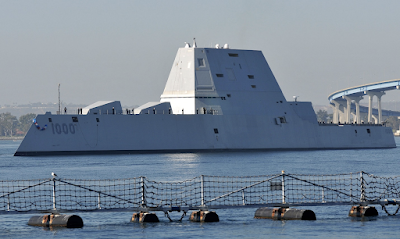
As part of the FY 2023 submission, the Pentagon proposed cutting warships from the Navy’s battleforce – including six cruisers, four Whidbey Island/Harper’s Ferry-class amphibious Dock Landing Ships, nine Littoral Combat Ships as well as Montford Point and John Glenn.

The youngest ship on the list, USS St. Louis (LCS-19), commissioned in 2020.

Years before LCS hull-1 was commissioned, we tried to warn the Navy what they were setting us up for. Long time members of The Front Porch know the story well, new folks can click the LCS-tab to catch up on a couple of decades of discussion.

I'm not sure even in our darkest moments we saw it coming to this much ruin...but perhaps we were optimists.

Imagine being one of the Sailors assigned to the St. Louis. "So, what did you do in the Navy?"

...and yet - where is our accountability for such a potlatchish waste of institutional capital and taxpayer money?

The above is clearly a generational failure by The Potomac Flotilla, and in an article by our friend Jerry Hendrix over at NRO, we have another example where The Potomac Flotilla has intentionally steered our Navy in to shoal water with barely a whistle, 

On Tuesday, the conservative Heritage Foundation released its annual “Index of U.S. Military Strength.” For the first time in the near-decade-long history of the index, it rated the U.S. military as “weak.” Implicitly criticizing multiple administrations, Heritage’s analysts charged that U.S. military forces are under-strength, under-trained, and under-funded, and thus are not ready to meet the current challenges of great-power competition. Heritage highlighted in particular the small size and poor material condition of the U.S. Navy and Air Force, which will be critical in facing a potential conflict in the Asia–Pacific region.

None of these failures are the fault of the Sailors and company and field grade officers in the Fleet - the ones our Navy has no problem holding to very public account for their failures - but of the senior uniformed and civilian leaders spanning multiple administrations ... and yet - who is being held to account?

Combine this with the fact that we tried to tie the loss of a multi-billion dollar large-deck amphib around the neck of an undesignated Seaman only to have him found not guilty after two years ... with still no one of note held to account but scapegoats ... where do the American people have to go in order to have their military leadership held to account?

Where? When? Who?

This should not be how any of this works.

Monday, August 29, 2022

The Eeyore Leadership Model for Our Navy

To paraphrase Papa Salamander's favorite saying, "No one owes you a Navy."

It has been eight decades since there was such a great gulf between the Navy our republic needs to meet a growing threat and the Navy its leadership was planning to have.

As we discussed a month ago, the institutions everyone is relying on to make the future fleet have failed their moment in time. 

Another reminder broke above the ambient noise last week, and it wasn't an easy read for navalists looking for firm leadership who - at least in words - give the impression that they have not given up the fight for what we know we need should conflict come in the next decade west of Wake.

Good thing I listened to AEI's scholars Hal Brands and Michael Beckley on The Remnant Podcast to discuss their recent book Danger Zone: The Coming Conflict with China. Folks smarter than me get it ... but it was a little discouraging that they sounded as frustrated - or more - than I am to what looks like a disaster we are sleepwalking in to. 

It isn't that the SECNAV and CNO don't know what time it is - they get better briefings than I do - they just seem to have thrown in the towel and are not up for the fight.

The SECNAV sounds, well, like he wishes he took a different job. Looking at his All Hands Message last week, well ... this isn't quite, "Join me in the battle to get our Navy the resources it needs." battle cry to inspire navalists;

....enhance our strategic partnerships, across the Joint Force, industry, academia, and nations around the globe. Those partnerships are critical in everything that we do. There’s no doubt in my mind about it. 

I don’t know that we’ll be able to ever match one for one, the number of ships that China is producing. But what I do know is that we can build a very large ‘Navy’ made up of all the ships of all our allies and partners around the globe working together collectively as one, in support of our mutual interests.

So, the Navy needs adopt a passive posture to continue to bend the knee to the Army's Cult of the Joint, publicly traded companies who have payrolls to meet, the grievance studies department at Oberlin College, and act-2 of Mike Mullen's wildly successful "1,000 Ship Navy™?"

Really?

Well, if that didn't make you proud and want to recommend to young men and women to join the Navy, this should do it;

...we must all speak up, speak out, and take action to eliminate sexual assault, sexual harassment, and racism from every part of our force. 

Disrespectful remarks, jokes, and actions contribute to an environment that increases the risk of assault, it weakens our force, and puts our Nation at risk.

Well, that message was almost designed to depress, so let's see what surge of energy the CNO provided to everyone as we get ready ponder the 1-year anniversary of our greatest national dishonor since the fall of Saigon;

“We have an industrial capacity that’s limited. In other words, we can only get so many ships off the production line a year. My goal would be to optimize those production lines for destroyers, for frigates, for amphibious ships, for the light amphibious ships, for supply ships,” Gilday said at a Heritage Foundation event.

“We need to give a signal to industry that we need to get to three destroyers a year, instead of 1.5, that we need to maintain two submarines a year. And so part of this is on us to give them a clear set of – a clear aim point so they can plan a work force and infrastructure that’s going to be able to meet the demand. But again, no industry is going to make those kinds of investments unless we give them a higher degree of confidence.”

Asked by USNI News after the event if the reason the Navy isn’t ready to send that signal to industry is because of funding, Gilday said, “it depends on the class of ships. Sometimes it’s affordability. Sometimes it’s industrial capacity.”

There is no reason why we should continue to play lip service to an obsolete system created at the creaking end of the Cold War 40-years ago and intellectually vapid Cult of the Joint that goes with it.

We don't have creative friction, we have complacent concurrence. 

We need someone, anyone really, to help build a pulse that will drive Congress towards a modern version of the Naval Expansion Act, 14 June 1940.

The CNO is close...very close...but like the SECNAV this is passive - diluted of vigor, and drive. 

We either have a moment of greatest threat from China or we do not. 

If we do, we need to act as such. If not, then by all means, maintain course and speed.

Post script: As I found out this AM as this post was in draft, our friend Jerry Hendrix is seeing the same need outlined a few lines above. Give it a read.

Monday, August 22, 2022

A Rust-Busting Renaissance?


After an absolutely dreadful decade long record failure of the most basic of all naval requirements - corrosion control - could our long navalist nightmare (at least this one) be coming to an end?

As in most things, ignore the excuses and emotional responses (some of the worst, by serving naval officers of all things was, "It is just a sign of how hard we are working." - as if no navy ever worked harder than the <checks news feed> US Navy at peace) - watch what naval leadership is saying, and look with your own eyes at what you see.

An interesting story from Mike Glenn over at The Washington Times this weekend is worth your time to read. It quotes some of our favorite people and opens with a quote from April that seemed to run under my radar.

The Navy’s top admiral has acknowledged how crucial the anti-rust campaign is for the service, militarily and aesthetically.

“Appearance is important. You’ve got to look sharp,” Adm. Mike Gilday, the chief of naval operations, said in April at the Washington-based Center for Strategic and International Studies. “We’re the world’s premier navy, [and] we’ve got to look like it.”

I think the boss sent a signal.

Where was this top cover a few years ago when David Larter, Chris Cavas, your humble blogg'r, and scores of others were beating a drum over this HUGE problem?

Well, a different story for a different day I guess ... but the pressure perhaps in some way helped move the needle. You can't change things overnight in such areas, but the April comment by the CNO (a careful man not prone too often - Kendi aside - of getting over his skis) starts to fold in to two other things I've noticed this summer. 

First was reports from people whose opinion I respect like Alessio Patalano (whose photos are used in this post with his permission) on the condition of our DDG during RIMPAC this summer. As you can find documented in the links earlier, we have not always done our best in high profile appearances. Nice change.

Second was the fun article on the 26-year old USS Benfold's (DDG 65) new enthusiasm - and success - it putting her in to proper shape. There was some carping from the cheap seats about, "Why are you asking for a BZ for doing what you are supposed to do anyway ... " but not from me. Yes, it shouldn't be news, but it is - and that means it is helping to set a "new" "old" standard ... as such it should be praised and encouraged. 

However, it is one ship and we can't overuse its example. We have a few hundred ships ... we should have more than one to point to. That is why I cringed a bit in the article here;
The Navy denies neglecting shipboard preservation. Cmdr. Arlo Abrahamson, a spokesman for the commander of naval surface forces in the Pacific, said the command’s crews devote “considerable time and energy” to balancing operational requirements and maintenance needs of their warships.

“We take a methodical approach to preserving our ships, synchronizing efforts with other maintenance requirements to ensure ships are ready and fully mission-capable,” Cmdr. Abrahamson said in a statement to The Washington Times. “We address these preservation challenges quickly at sea, after ships return to port, and during maintenance phases.”

Cmdr. Abrahamson pointed to the example of the USS Benfold, a guided-missile destroyer whose captain created a full-time maintenance group focused on preventing external shipboard corrosion, even while at sea.

“The team is hands-on busting rust, priming or painting every day except Sunday,” said Petty Officer 1st Class Alexander Polk, who is part of the Benfold restoration team. “Every week, we conduct a job review board and discuss upcoming jobs.”
No show ponies.

This was a lost opportunity. The record is clear that, yes, for well over a decade our Navy did neglect the material condition of our fleet. Do I need to point again to how we showed our stern to Kiel? That was only three years ago. We really need to stop spinning. There is nothing wrong with saying we are fixing a - pun intended - soft spot in our approach to preservation. 

I don't know who is setting the standards for our PAO's, but we do not help the reputation of those in uniform by sounding like the worst White House press briefing spin.

Yes, everything Abrahamson says is true ... but in context - no offense intended Arlo - it comes out slimy. 

There is a reason this is an important topic. It matters. In the article, Jerry Hendrix summarizes nicely;
“It’s having an impact on our standing in the world. That’s something the Navy really needs to come to grips with,” he said. “Influence is greatly tied to perception. If the perception is that your ships look terrible, that’s the perception of the country: ‘Our fleet is old and it’s tired and that we as a nation are old and tired and appear run down.’”
That is rock-solid correct.

Another CAPT., USN (Ret.), Carl Schuster of HPU, speaks a simple truth that needs to be repeated - it seems - every day until people are sick of hearing it;
“If you’re not willing to maintain the ship and preserve the hull and superstructure, what else are you ignoring in terms of maintenance?” he asked. “What else are they not taking care of?”
This is backed up by CMDCM Thomasson of the Benfold who states what used to be a universal, but sadly to many ears, seems "new." Master Chief knows ... and always knew;
Navy Command Master Chief Andrew Thomasson, the senior enlisted sailor aboard the USS Benfold, said his sailors take great pride in the condition of their ship. 

“When a ship looks pristine, new and looking her best, our enemies hesitate to mess with us because when we’re looking our best, we obviously must be performing at our best,” he said. “And just the opposite when we look dirty and rusty. When a ship is looking her best, just look at it as saving lives.”
As we have called for over the last decade, we need to prioritize material condition. We need a reset. We need to deploy less, increase at sea manning, and allocate resources until we get a better balance. For two decades we have refused to say no, and the fleet has suffered.

Could we already be in the early phases of a renaissance in the neglected areas of material condition? 

Perhaps. I hope so.


Monday, August 15, 2022

The Case for American Shipbuilding

To build the Navy we need, the one thing we have to get right is - and this seems obvious - to successfully build ships. A lot of them.

Easy to type, hard to do.  While we have had many well-documented troubles this century, we also have some notable successes that give hope we can do it right when we want to.

Returning today with another top-shelf guest post, Bryan McGrath picks up the conversation with a reminder of what we did get right, and what we need to do with that institutional capital.

Bryan, over to you.


When a “Murderers Row” of Navalists (Hendrix, Salamander, Work) all take to the interwebs within the same week to opine on the recent pathologies of American naval shipbuilding, one is forced to take note. As I toil and scribble in the same lanes as these fellows, I feel called to add my thoughts to the mix, some of which track well with theirs, some of which are not well-aligned, and some of which touch on issues their essays chose not to address. Their flurry of essays provides occasion to reflect upon the state of naval shipbuilding in the United States. With China’s naval expansion proceeding at an alarming pace and multiple studies converging on the finding that the U.S. Navy is too small, America must build more warships. This need is complicated by recent, well-documented descriptions of delays, cost overruns, and technical failures, raising questions about whether the United States is up to the task. This essay asserts that it is, but only if tough lessons are implemented, sufficient resources are applied, common sense is embraced, and political will is demonstrated. Some of this my esteemed colleagues touch on, some they do not. 


The Acquisition Kluge

The first thing to consider before we bend any steel or take to the computer-aided design software is that the acquisition of Navy warships exists within a complicated cauldron of interlocking systems and stakeholders to include executive branch policy making, legislative branch resourcing, Department of Defense/Navy budgetary prioritization and strategy-making, and industrial base concerns, to name only a few. There are no silver bullets, there are no magic beans. The act of acquiring warships is hard, and countless trade-offs among and within these systems are a feature, not a bug. 

This complex kluge creates numerous perverse incentives among the stakeholders. At the national level, we are unable to make coherent grand strategy, and so what kind of and how big a Navy we need devolves to slight deviations from the Navy we have, even when that Navy is patently insufficient. When the Navy does seek to develop a new class of ship, it consistently understates both the cost of the first in class and the life-cycle costs that it will incur. Why? Because everyone involved has an interest in keeping “sticker shock” from derailing the acquisition, including Congress. Better to get the program up and operating and ask for more money later than to drive away interest in a program due to its expense. 

Compounding this kabuki is the problem of immature designs, and much of the blame here belongs in the Pentagon. Whether one points to Secretary of Defense Rumsfeld’s “transformational” edicts to both the FORD Class CVN program and the DDX program (now the DDG 1000) resulting in the parallel integration of numerous immature technologies, or the similarly “transformational” decision to provide potential LCS vendors with “performance specifications” rather than “design specifications” (resulting in brittle supply chains and the introduction of one-of-a-kind and unproven technology in main propulsion 


USS ZUMWALT (DDG 1000)

and combat systems), the pathologies of all three programs (CVN, DDG 1000, and LCS) are in part the result of immature designs incorporating unready, untested, and unsupported technology. Additionally, as part of the post-Cold War move to favor “efficiency” (over effectiveness), the Navy’s own technical community was dramatically down-sized, resulting in a situation in which it attempted—under pressure from OSD and from its own questionable decision-making—to oversee the development of increasingly complex warships with unfamiliar technology utilizing a workforce that was not up to the task. This was a recipe for failure, and three ship classes suffered as a result. 


Is All the News Bad?

Reading the thoughts of my friends Jerry Hendrix, Bob Work, and Commander Salamander on the turmoil in naval shipbuilding of the past two decades provides a depressing but incomplete picture of the status of American warship building. The United States is at this moment, building several classes of ships that are the envy of the world-- effectively and efficiently--to include the VIRGINIA Class attack submarine, the ARLEIGH BURKE Class destroyer, and two classes of large amphibious ships (LPD and LHA). The Navy and the Congress possess such confidence in these ships that they are routinely acquired in batches, rather than with individual contracts for each hull. What is the difference in these ships and the three (CVN, DDG 1000, LCS) discussed earlier?

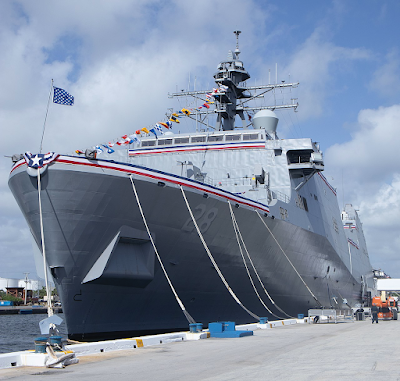
The simple answer is that they are mature programs with generally stable designs. The ship pictured below at its recent commissioning ceremony--USS FORT LAUDERDALE (LPD 28)—is the beneficiary of years of construction experience and what the industry calls “learning”. More efficient processes are created, early design problems are overcome, and real costs decline the longer a production line remains open. The VIRGINIA Class SSN, DDG 51 class, and the LPD 17 class all had early problems to overcome, but the Navy and the shipyards—with considerable oversight from Congress—worked those problems out and put the programs on a steady course. As of this writing, it appears that similar conditions are prevailing in the construction of follow-on FORD Class CVN’s. 

The point here is that America CAN build ships; it builds GREAT ships. But given the pace of China’s Navy buildup and the considerable number of new and newly modernized ships in the pipeline, how can the Navy and other stakeholders in the acquisition process behave differently to achieve positive results earlier rather than later?


What Is to Be Done?

In his recent guidance to the Navy’s Surface Forces called “The Competitive Edge”, VADM Roy Kitchener USN (Commander U.S. Naval Forces) identified ten “new or modernized platforms” that will join the fleet or be in construction over the next ten years. Those platforms are: 

  • ZUMWALT-Class Destroyers (DDG 1000) with Conventional Prompt Strike (CPS)
  • ARLEIGH BURKE Class Guided Missile Destroyers (Flight III)
  • ARLEIGH BURKE Class Guided Missile Destroyers (Flight IIA Modernization)
  • LCS Lethality and Survivability Upgrade
  • CONSTELLATION-Class Guided Missile Frigate (FFG 62)
  • Light Amphibious Warship (LAW)
  • Medium Unmanned Surface Vessels (MUSV)
  • Large Unmanned Surface Vessels (LUSV)
  • SAN ANTONIO Class Amphibious Transport Dock (LPD 17 Flight II)
  • Next Generation Guided Missile Destroyers (DDG (X))

This is a considerable amount of complexity entering the fleet in the next decade, and unless lessons from the past twenty years of frustration are implemented among all the various stakeholders, that frustration will continue. Here are several suggested focus areas:

Design Maturity. Civilian and uniformed leadership of the Navy should be required by Congress to certify design maturity and maturity of new technologies prior to proceeding to construction. Concurrency must be avoided at all costs, and new capabilities should be developed and proven in land-based test facilities PRIOR to introduction. Exceptions would include corrections of obvious mistakes, and changes to ships that are built at wider intervals (like aircraft carriers and amphibious assault ships). Of note, well into the Biden Administration’s second year, the Navy does not have a Senate confirmed Assistant Secretary for Research, Development, and Acquisition (ASN RDA), nor has one been nominated. 

Additionally, Congress must play a constructive role here by providing funding for design and testing to support Navy acquisition timelines and for additional land-based test capacity (an unsung Congressional achievement of late). These funds are often harvested and re-applied elsewhere, which causes acquisition delays (at best) and at worst—contributes to design immaturity as the Navy rushes to meet production schedules. The best of all cases from a Congressional oversight standpoint is to provide the design and testing resources when they are requested but to relentlessly hold the line on construction until satisfied of design and technology maturity. Long lead-time material must be closely managed to ensure availability.  

Requirements Discipline. When and if this country becomes serious enough about force structure to seat a Senate-confirmed official at ASN RDA, that individual must be utterly ruthless in shooting down the good idea fairy, even if that fairy appears in khaki with several stars on the collar. Multiple iterations of mature designs should be constructed to reap pricing benefits, with (as stated above) changes and capabilities proved and binned awaiting a new “tranche” of ships into which they will be integrated. 

A Virtuous Cycle of Stability and Investment. There is, within the latest Navy 30 Year Shipbuilding Plan, discussion of industrial base concerns in both the surface and submarine shipbuilding narratives, with no less an authority than the CNO casting doubt. Building multiple VIRGINIA Class SSN’s and the COLUMBIA Class SSBN simultaneously will surely flex the submarine industrial base, but the suggestion that there is not additional capacity in the surface industrial base is misplaced (although skilled workforce issues impact shipbuilding as much as most other industrial concerns). Where there are serious problems is within the supply chain, as tier 2 and 3 suppliers exit their businesses in response to inconsistent demand signals from the Navy. This inconsistency is important to the entire industry, as publicly held businesses must answer to shareholders who would (rightly) question capital investments driven by the behavior of their monopsonic partner. 

Leverage Hot Production Lines. Both tier 1 shipyards (HII and Bath Iron Works) are transitioning to the Flight III DDG line of ARLEIGH BURKE Destroyers—HII from building Flight II’s, and BIW from building DDG 1000’s.  The first hull at HII is nearing completion, and the first at BIW is under construction. Hot production lines also exist in the LPD 17 program and the LHA program. The Navy should plan to and budget for AT LEAST 2 SSN’s a year (in addition to the required SSBN program), 2 large surface combatants a year, 1 LPD 17 every other year, 1 LHA every four years and 1 CVN every five years. 

USS FORT LAUDERDALE (LPD 28)

For those hearkening back to paragraph three where I stated “…what kind of and how big a Navy we need devolves to slight deviations from the Navy we have…”, be advised that what I suggest above is just a part—a large part, but just a part—of the building program we need. We (the kluge cited earlier) have dithered long enough on unmanned platforms on and under the ocean, and the dearth of new Medium USV acquisitions in the President’s FY23 budget is concerning. A third of the 2045 fleet is to be unmanned, and if we hope to get there, we need to start bending metal, much of which will be done at more modestly sized yards. And then there is the new frigate. 

Compete the CONSTELLATION Class As Soon As Possible. It is difficult to see in the Navy’s plans a desire to bring on a second yard to build the CONSTELLATION Class frigate any time soon. Whether this is an architecture decision, a resource decision, or a risk decision is not known to me, but it is logical to assume that if the Navy is to grow larger in the coming years, more of these ships must be built. The design chosen by the Navy—while based upon a successful European hull—is considerably different from the parent design, in no small measure due to requirements for survivability driven by NAVSEA. Those requirements are often seen as onerous, but one important fact distinguishes STARK, SAMUEL B ROBERTS, PRINCETON, TRIPOLI, MCCAIN, and FITZGERALD from MOSKVA, and that is that only one of these ships went to the bottom. That the yard chosen to build CONSTELLATION has never built a ship of this size and complexity before is even more reason to expeditiously compete the design among the other building yards, both to get to at least four hulls per year and a means of backstopping production risk. Some would caution against this path, citing the need for the Navy and its shipbuilding partner to “learn” from the first hull. While there is indeed learning to be done, there is precedent worth considering in the transition from building CG 47’s to DDG 51’s. Bath Iron Works won the contract for the ARLEIGH BURKE, and Ingalls began construction on BARRY two years after ARLEIGH BURKE construction began, with the yards competing on hulls and multi-year procurements ever since. 

Like I said earlier, shipbuilding is hard. But it is harder when costs are consistently and predictably under-estimated (I’m no math major, but there seems to be a fudge factor suggested here), when the key policy and oversight positions are not filled, when construction begins before plans are ready, when considerable changes are made from hull to hull without discipline and testing, and when there are dramatic swings in shipbuilding plans that frustrate coherent capital investing. 

The nation needs a larger Navy; it needs more of the same and it needs more of different. It needs capacity and capability. It needs more, and more predictable resources. More than anything else though, it needs this country’s national security decision making elite to walk away from any notion that the Navy the nation needs can be had on the cheap, that other instruments of government can make up for what the Navy does every day around the world, and that we can “technology” our way out of the seapower deficit we are in. Winter is coming.


Bryan McGrath is the Managing Director of The FerryBridge Group LLC. He has clients in government and industry. His public writing and speaking represents his own opinions. 

Tuesday, August 09, 2022

Overspec'd, Overpriced, all Navy: Bob Work on Institutional Addictions


Last Wednesday I had a few observations on Jerry Hendrix's latest article over at National Review, The Navy’s Littoral Hubris.”

Yesterday in comments, a man familiar to readers here, former Deputy Secretary of Defense Bob Work, weighed in with some counterpoints that I feel need to be brought above the fold for your consideration.

With his permission, I've copied his comments in full.

There are the bones of one hell of a book here in six short paragraphs.  

Bob, over to you;


As he always does, my good friend Jerry writes a compelling, well written post. However, I think he misses an important point. The problems the Navy has faced has less to do about technological hubris and more with incompetence in developing cost-informed requirements and executable support processes.

Let's start with the Ford CVN. Back in the day-- around the time of the 1993 Bottom Up Review, long before the word transformation had found its way into Pentagon thinking--the Navy and Air Force were competing for the "rapid halt" mission. The thinking went that the enemy could launch an invasion of allied territory at a time of their own choosing. The job of the Joint Force was to halt the invasion as quickly as possible through intense guided munitions bombardment. The Air Force argued the best way to do this was using bombers and regionally based aircraft, which enjoyed a big advantage in sortie rates from land bases. The Navy was intent on proving they could match sortie generation rates from forward deployed carriers. To do that, they needed a new electromagnetic catapult system; an electromagnetic arresting system; new high speed low drag elevators, etc etc etc. They called for these new capabilities with no clear understanding of the cost to get them, or a sensible land-based prototyping and testing approach to work out the bugs before shipboard integration. It is true that OSD demanded that all the new technologies be incorporated into the first ship of class of the new CVNX (later Ford), rather than inserting them over the first three hulls. That caused a technology integration overload. But the original sin was setting new requirements with no clue how much it might cost to get them.

Then came the DD-21, aka DD(X), aka DDG-1000. The surface community knew that the 31-ship Spruance class was going to start decommissioning starting in 2005 (that was the plan, anyway). The community needed a plan to replace them. The community was also tired of taking a back seat behind the carrier and sub forces, a circumstance they were force to tolerate throughout the long Cold War. And it wanted to get in on the rapid halt mission. The arsenal ship was a conceptual start point. But the surface community wanted something even more exotic. So they called for a stealthy surface ship with deep magazines--missiles, or guns, or both. OSD was not the one pushing the stealth design. That was all Navy. And, in the end, the Navy designed a 15,000-ton battle cruiser with a hull that was literally too expensive to produce. The ship suffered the same technological overload at the Ford class, but the over-spec-ing of the ship was all Navy, not OSD. Again, these were sins of the Navy.

The LCS is a more complicated story. OSD told the Navy that OSD would not support their DD(X) unless there was a smaller combatant in the Navy's battle force. The Navy decided to get out of the frigate business during the 1997 QDR--again, a Navy decision. This meant the smallest surface combatant in the 21st century fleet would have a full load displacement of nearly 9,000 tons (DDG-51 Flt I). OSD didn't think the Navy could afford to build and maintain such a fleet. They were, of course, spot on...see fleet of today. The ONLY requirement OSD levied on the LCS program was that the Navy needed to be able to build three of the ships for the same cost as a DDG-51. And guess what? The Navy hit that mark. We just forget about it--and how important a metric it was.

Cost aside, the crewing, training, maintenance and deployment process decisions were all the Navy's to make. But every choice ultimately proved to be beyond the ability of the surface community to execute them. This was a case of process, not technological, overload. It appears the surface community may be finally figuring things out on the ship. But no objective review of the LCS fleet transition plan would conclude anything other than it was abysmally bungled.

The reason I think we have to remember these vignettes is we need to ask ourselves if we are about ready to repeat the process. IT DOES NOT MATTER THAT THE NAVY CHOSE A PROVEN DESIGN FOR FFGX. The Navy is cramming as many requirements and capabilities into the FFGX hull as they can. Eric Lab at CBO is convinced the Navy has once again overspec'd the ship and underestimated the costs to build it. I hope he is wrong. But if we can't build a minimum of two FFGXs for the cost of a DDG FltIII, it is not clear it is worth the cost, or the smaller fleet it will inevitably lead to.


Robert O. Work spent 27 years on active duty as a Marine artillery and MAGTF officer. He is a former Undersecretary of the Navy and Chief Executive Officer of the Center for a New American Security. He served as the Deputy Secretary of Defense alongside three Secretaries of Defense spanning both the Obama and Trump administrations.